
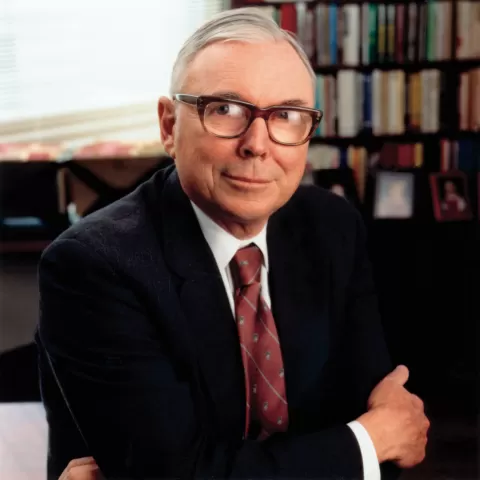
Charlie Munger: incentives, errors in judgment and decision-making COMBATIVES
COMBATIVES · DECISION MAKING
Smart people make bad decisions too.
Charlie Munger spent decades trying to understand an apparently simple question: why do capable, experienced and well-informed people continue to make predictable mistakes?
Charles Thomas Munger was born in 1924 and died in 2023, just a few weeks before his 100th birthday.
Trained as a lawyer, an investor and for decades vice chairman of Berkshire Hathaway, he became known not only for his investment decisions but especially for the way he thought about judgment, incentives, human error and decision-making.
Warren Buffett later described him as the architect of Berkshire Hathaway, recognizing Munger's influence on the transformation of the company's investment philosophy.
For COMBATIVES, the interest is not in financial markets.
It is in the question behind them: how can we reduce the probability of making a bad decision when our own mind is part of the problem?
HUMAN MISJUDGMENT
Error does not necessarily begin with a lack of intelligence.
One of Munger's best-known works on human behavior became known as The Psychology of Human Misjudgment.
His interest was in psychological tendencies capable of distorting judgment even when a person believes they are reasoning objectively.
Incentives, confirmation of existing beliefs, social influence, authority, reciprocity, fear of loss, commitment to previous decisions and other forces can act simultaneously.
The problem, therefore, is not simply ignorance.
It is possible to have enough information and still interpret the situation badly.
INCENTIVES
Before asking what someone says, look at what the system rewards.
Incentives can change behavior without a person clearly realizing how much their own judgment has changed.
Munger placed enormous importance on the power of incentives. He called one of their consequences incentive-caused bias.
A person may begin by justifying to themselves a decision that also happens to serve their own interests.
This does not necessarily require deliberate corruption. The incentive itself can alter how the problem is perceived.
A poorly designed reward structure can produce bad decisions even within an organization made up of competent people.
MENTAL MODELS
One model cannot explain the world.
Another central element of Munger's thinking was the use of mental models drawn from different disciplines.
Economics may explain one part of a problem. Psychology may explain another. Statistics, biology, engineering, history and other fields can reveal aspects that a single discipline may miss.
The risk appears when someone knows one tool deeply and begins interpreting every problem through it.
When you have only one model, you begin trying to fit reality into it.
INVERSION
Sometimes it is more useful to ask how everything could go wrong.
Instead of searching only for the perfect decision, Munger frequently used inversion: examining the problem from the opposite direction.
Instead of asking only: “How do I get a good result?”
we can also ask: “Which mistakes would make a bad result much more likely?”
The difference seems small, but it changes the reasoning.
Many situations do not require genius. They require avoiding predictable mistakes.
COMBATIVES APPLICATION
Violence also produces errors in judgment.
Fear, ego, social pressure, previous experience and expectations can alter the way we interpret a situation.
Munger's work was not developed as a theory of personal protection.
But some of his tools are useful for thinking about decisions in conflict environments.
A person may stay in an argument because they do not want to appear weak. They may ignore new information because they have already chosen a course of action. They may interpret behavior according to what they expected to find. They may follow other people simply because everyone seems to be doing the same thing.
In those moments, the problem is not a lack of physical technique.
The problem may lie in the judgment that came before the action.
DECISION QUESTIONS
Better questions can prevent worse decisions.
What is the incentive?
Who gains something if I make this decision?
What am I failing to consider?
Is there information that contradicts what I already believe?
Am I defending an old decision?
Continuing because I already started does not mean continuing is still the right decision.
Am I following the group?
The fact that other people are doing something does not automatically make it a good decision.
How could this situation go wrong?
Thinking about possible failure may reveal risks that an analysis focused only on success can miss.
LIMITS
Munger did not develop a science of violence.
Charlie Munger was an investor, businessman and lawyer. His work on human judgment should not be presented as clinical research, criminology or behavioral threat assessment.
His contribution here is different.
He offers intellectual tools for examining how incentives, biases and mental models can distort decisions.
For COMBATIVES, these ideas complement the specific study of violence, behavior, prevention and protection — they do not replace those fields.
COMBATIVES NOTE: the applications related to conflict and protection presented in this article are educational interpretations by COMBATIVES. They should not be attributed to Charlie Munger as a theory of self-defense or violence prevention.
SOURCES & FURTHER STUDY
References for further study.
Poor Charlie's Almanack
A collection of Charlie Munger's speeches and ideas on thinking, mental models, behavior and decision-making.
Poor Charlie's Almanack — Stripe Press
The Stripe Press edition of the collection devoted to Munger's speeches and thinking.
Berkshire Hathaway — 2023 Annual Report
Berkshire Hathaway's annual report published after Charlie Munger's death, including Warren Buffett's text “Charlie Munger — The Architect of Berkshire Hathaway”.
Charlie Rose — Charles Munger Archive
Archive of interviews and appearances by Charles Munger.
COMBATIVES
Knowing more is not enough. We need to make fewer mistakes.
Some bad decisions do not happen because information was missing. They happen because we misinterpreted the information we already had.