
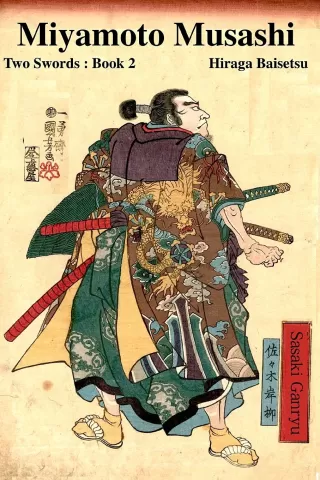
Miyamoto Musashi: perception, rhythm and adaptation in conflict COMBATIVES
COMBATIVES · STRATEGY & CONFLICT
The name became legend. The text is more interesting.
Miyamoto Musashi is often reduced to three ideas: undefeated samurai, two swords and dozens of duels. The Book of Five Rings presents a much broader problem: perception, rhythm, distance, initiative and adaptation.
Miyamoto Musashi lived in Japan between the late sixteenth century and the first half of the seventeenth century.
He was a swordsman, strategist, author and artist.
In his own Gorin no Sho — The Book of Five Rings, Musashi states that he began dueling while still a teenager and that, by approximately age 29, he had taken part in more than 60 encounters without being defeated.
That account comes from Musashi himself.
It does not mean that every duel can now be independently verified.
The more interesting point appears in what he writes next: Musashi does not automatically attribute those victories to perfect strategy.
He admits that he may have possessed natural ability or simply faced inferior opponents.
That doubt already separates the historical text from the legend built later.
LEGEND VS. SOURCE
Musashi's biography accumulated centuries of narrative.
Part of Musashi's popular image comes from records produced decades after his death, martial school traditions, theater, prints, novels, film and popular culture.
That does not make the entire tradition false.
But it requires separating what Musashi wrote, historical records close to his lifetime and later narratives.
To understand his strategic thinking, the most important source remains The Book of Five Rings, completed near the end of his life.
In that text, he speaks far less about heroism than about observation, timing, distance, initiative and training.
PERCEPTION
Looking is not the same as perceiving.
Musashi distinguishes between what the eyes simply see and the ability to perceive the situation as a whole.
In the Water Book, Musashi distinguishes two ways of looking, traditionally translated as perception and sight.
The direction is clear: strengthen perception and avoid becoming trapped by visible detail alone.
He also recommends perceiving what is distant as though it were near and maintaining perspective on what is near.
This is not a mystical ability.
It is a problem of attention.
Fixating excessively on a sword, a hand or a movement can reduce the ability to understand the entire situation.
RHYTHM & TIMING
For Musashi, conflict has rhythm.
Rhythm appears repeatedly throughout The Book of Five Rings.
Musashi observes that music, work, commerce, war and combat have timing, cadence and changes in rhythm.
Strategy requires recognizing the appropriate timing and the inappropriate timing.
This includes perceiving relationships between speed, distance, initiation, interruption and change.
The advantage is not simply in being fast.
A movement can be fast and still happen at the wrong moment.
Speed and timing are different problems.
DISTANCE
Before technique, there is a relationship of distance.
An action does not exist in isolation. It depends on the position between people, the time required to reach them and what each person is capable of doing from there.
Musashi gives constant attention to distance.
Not only to the physical reach of a sword, but to the moment when an action can or cannot reach the opponent.
Distance and timing work together.
Being too close or too far away changes the usefulness of a technique.
What works at one range may stop working when the distance changes.
This is one reason why a collection of isolated movements explains so little about real conflict.
TWO SWORDS
The two swords were method. Not decoration.
Musashi did not want the practitioner to depend on a single way of using a weapon.
The samurai normally carried a long sword and a short sword.
The innovation associated with Musashi's school, later known as Niten Ichi-ryū, was the systematic development of using both simultaneously.
In The Book of Five Rings, Musashi argues that the warrior should understand the possibilities of the weapons he carries and should not die with one of them still unused.
But reducing this to “Musashi fought with two swords” misses the more interesting part.
The principle is not allowing a tool to become a dependency.
TOOLS
The weapon must serve the situation.
Musashi does not discuss only the sword.
In the Ground Book, he also examines the spear, naginata, bow and firearm, observing that each instrument has advantages and limitations related to terrain, distance and situation.
That matters.
The tool does not define the strategy by itself.
Context determines when a tool is useful.
Becoming attached to a single weapon, technique or preference can reduce options when the environment changes.
NO FIXED FORM
Technique should not imprison the decision.
One of Musashi's recurring themes is not becoming trapped by positions, rhythms or responses simply because they have been trained.
In the Water Book, after presenting positions and ways of handling the sword, he himself qualifies their importance.
The position exists to enable action.
It is not the objective.
If a form of movement no longer serves the situation, the situation should not be forced to fit the technique.
Technique is a tool. Reality is the problem.
THE OPPONENT
Understanding the other person changes the decision.
Musashi does not study only what he intends to do. He studies what the opponent is trying to do.
In the Fire Book, Musashi repeatedly works with intention, initiative, hesitation, rhythm and the opponent's reaction.
In some passages, the objective is to recognize what the other person intends before the action is fully developed.
In others, it is to alter rhythm, interrupt an intention or create a situation in order to observe the response.
This changes the logic of combat.
Instead of thinking only: “which technique am I going to execute?”
another question appears: “what is happening between us right now?”
PRACTICE
Reading the book was not enough for Musashi.
The Book of Five Rings was not written as a collection of abstract thoughts.
Musashi repeatedly insists on practice, repetition and embodied understanding of the principles.
The reader was not supposed merely to memorize what had been written.
The principles were to be tested through training.
This also helps avoid a common modern reading: removing Musashi's statements from their martial context and turning them into slogans about business, leadership or life.
COMBATIVES APPLICATION
The repertoire is not the center.
The response must continue to follow distance, rhythm, environment and behavior.
Musashi lived in another period, used weapons and faced conditions that should not be confused with contemporary personal protection.
But some of the problems he studied remain recognizable in any form of physical conflict:
distance changes; people hesitate; actions produce reactions; rhythm breaks; obstacles interfere; tools have limitations; and plans stop working.
In that context, having more techniques does not eliminate the problem.
It is necessary to perceive when a response still makes sense.
COMBATIVES STUDY
What is worth taking from Musashi.
Perception before response.
Do not become visually or mentally trapped by a single detail of the situation.
Timing is not speed.
Doing something quickly does not mean doing it at the right moment.
Distance changes possibilities.
A response depends on where people are and how much time exists to act.
A tool is not a strategy.
Weapons and techniques are useful only within a particular context.
Do not become trapped by form.
A trained response must be capable of changing when reality no longer corresponds to the exercise.
Observe the opponent.
Conflict involves what the other person intends, perceives and is capable of doing.
A principle must survive practice.
Memorizing an idea does not demonstrate that it works when distance, resistance and pressure change.
LIMITS
Historical Musashi and legendary Musashi are not the same thing.
Many well-known episodes from Musashi's life were recorded decades after his death or expanded by popular tradition.
The number of duels and the claim that he was never defeated appear in the autobiographical account in The Book of Five Rings, but they should not be presented as independently verified modern statistics.
Nor is it historically possible to prove that Musashi “won because he saw first” in a literal sense.
What we can say is more precise: his own treatise places enormous importance on perception, distance, rhythm, initiative, observation of the opponent and adaptation.
That is already significant enough.
COMBATIVES NOTE: the applications related to protection and contemporary training presented in this article are educational interpretations by COMBATIVES. The Book of Five Rings was written within the historical context of Japanese strategy and armed combat.
SOURCES & FURTHER STUDY
References for further study.
Miyamoto Musashi — Gorin no Sho / The Book of Five Rings
Primary source for Musashi's strategic thinking, including perception, rhythm, distance, weapons, initiative and adaptation.
Miyamoto Musashi — A Book of Five Rings
English translation by Victor Harris, one of the best-known modern editions of Musashi's work.
Eisei Bunko Museum — The Book of Five Rings
The Eisei Bunko collection preserves one of the principal manuscript traditions of the Gorin no Sho, connected to the transmission of the work through Musashi's disciples.
British Museum — Miyamoto Musashi
Institutional record of Musashi as an author, artist and historical Japanese figure, including his connection to The Book of Five Rings.
William Scott Wilson — The Lone Samurai: The Life of Miyamoto Musashi
Modern biography of Musashi, useful for historical context and for distinguishing some of the available documentation from later traditions.
Eiji Yoshikawa — Musashi
Historical novel originally published in the twentieth century. It played an important role in shaping Musashi's modern popular image, but should not be used as a factual source for reconstructing his life.
COMBATIVES
Technique comes after reading the situation.
Distance changes. Rhythm changes. The other person changes. A response that does not change with them stops being useful.