
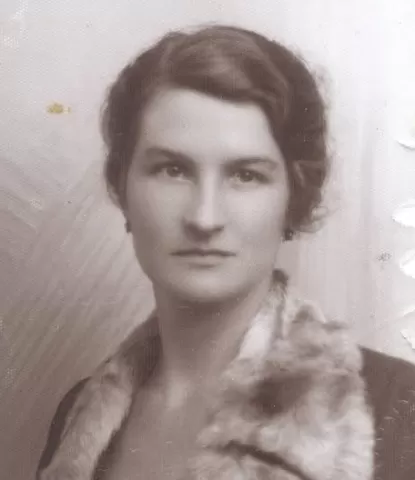
Virginia Hall and the advantage of not looking like a threat COMBATIVES
COMBATIVES · INTELLIGENCE & ADAPTATION
Being underestimated can also change a situation.
Virginia Hall operated in occupied territory using intelligence, cover, adaptation and discipline in an environment where being identified could mean imprisonment or death.
Virginia Hall was born in Baltimore, United States, in 1906 and died in 1982.
Before the Second World War, she wanted to pursue a diplomatic career. A hunting accident in Turkey resulted in the amputation of her left leg below the knee.
Her disability ultimately prevented her from entering the American diplomatic service at that time.
The war, however, would take her career in another direction.
Hall first worked for the British Special Operations Executive — SOE and later for the American Office of Strategic Services — OSS, one of the predecessor organizations of the future CIA.
SPECIAL OPERATIONS EXECUTIVE
Getting in was only the beginning.
In 1941, Virginia Hall was recruited and trained by the British SOE.
She received preparation in communications, operational security, weapons and activities supporting the resistance.
She was sent to France under journalistic cover and initially settled in Lyon.
Her work came to involve creating and supporting agent networks, maintaining contact with the resistance, organizing safe houses, helping prisoners and agents escape and coordinating clandestine operations.
The activity required something different from physical strength.
It required remaining functional while other people were trying to discover who she was.
PERCEPTION
Appearance and capability are not the same thing.
What someone appears capable of doing may be very different from what they can actually do.
Virginia Hall was a woman, a foreigner and used a prosthetic left leg.
None of those characteristics defined her operational capability.
At different times, she used covers, identities and appearances appropriate to the environment in which she needed to move.
When she later returned to occupied France working for the OSS, she deliberately altered her appearance and behavior to reduce the possibility of recognition.
The case shows a recurring problem of perception: judging capability by appearance can produce a completely wrong reading of a person.
NETWORKS
The work depended on other people.
Clandestine operations do not function through an individual agent alone.
Hall helped organize networks, recruit people for safe houses, establish contacts and maintain communication between resistance groups and Allied forces.
During her work, she also helped organize supply drops and supported agents and prisoners who needed to escape.
Later, working for the OSS, she would help identify drop zones, transmit information and organize French resistance forces.
Individual survival and network function were different problems — but they depended on each other.
WANTED
Eventually, discretion was no longer enough.
The Gestapo began actively searching for the agent known for her physical disability and clandestine activity.
Hall became known to the Germans as “The Limping Lady”.
Historical sources record that the Gestapo considered her one of the most dangerous Allied agents in operation and sought to locate her.
At that point, remaining in the same area was no longer merely difficult.
It had become unsustainable.
The problem had changed again.
ESCAPE · 1942
Staying was no longer courage. It had become risk.
When exposure increased, survival required leaving.
With the German occupation of the zone previously controlled by the Vichy regime, Hall's situation deteriorated rapidly.
In November 1942, she left France.
The route required crossing the Pyrenees on foot during winter to reach Spain.
Hall made the crossing using her prosthesis, which she called Cuthbert.
The physical difficulty was real.
But remaining in an environment where her identity was increasingly exposed represented an even greater risk.
RETURN TO FRANCE
Leaving did not mean abandoning the mission.
After escaping France and returning to Britain, Hall wanted to go back into occupied territory.
The SOE considered the risk too high.
Hall then transferred to the Office of Strategic Services.
In 1944, she clandestinely returned to France.
Because her appearance was already known to the Gestapo, she adopted a new identity and deliberately altered elements of her presentation.
CIA sources record that she even disguised herself as an older rural woman to reduce the possibility of recognition.
OFFICE OF STRATEGIC SERVICES
The environment changed. So did the method.
On her second mission, Hall had to work knowing that the enemy already possessed information about her.
Operating under the codename Diane, she maintained contact with resistance groups, transmitted information by radio, identified supply drop zones and supported sabotage activities against German infrastructure.
The CIA records that Hall helped organize and direct approximately 1,500 members of the French resistance during this phase of her work.
She also made dozens of clandestine transmissions from occupied France.
Radio transmission created constant risk because German forces were attempting to locate clandestine signals.
That required movement, discipline and continuous adaptation.
SURVIVAL
Survival was also part of the mission.
Continuing to operate required knowing when to stay, when to change and when to disappear.
Virginia Hall's story can easily be turned into a simplistic narrative about courage.
That misses an important part of the case.
Courage without discipline would have reduced her ability to keep operating.
Remaining visible when her cover had been compromised would not have been determination.
It would have been a mistake.
Hall survived because courage and adaptation were not treated as opposites.
COMBATIVES STUDY
What the case allows us to study.
Appearance does not determine capability.
Judging threat, competence or vulnerability solely by visible characteristics can produce serious errors.
Discretion can preserve options.
Not every situation requires presence, confrontation or a demonstration of capability.
The environment determines what works.
A behavior that is useful in one context can become dangerous when the adversary learns more about you.
Exposure changes risk.
When identity, pattern or location becomes known, the problem must be reassessed.
Leaving can be the correct decision.
Remaining in a situation simply to demonstrate courage can destroy your ability to act later.
Adaptation is not weakness.
Hall changed identity, appearance, location, method and organization as the environment changed.
Networks matter.
Even extremely capable agents depend on information, contacts, support and people with different skills.
COMBATIVES APPLICATION
Protection does not require looking dangerous.
In some situations, attracting less attention preserves more options than demonstrating capability.
Virginia Hall operated in war and espionage. That context should not be confused with modern personal protection.
But the case allows us to examine a common mistake: associating safety with demonstrating strength.
There are situations in which visibility, confrontation, ego and the need to show capability only increase exposure.
Protection can follow another logic: be noticed less, preserve options, understand the environment and leave before the situation forces a worse response.
LIMITS
Espionage is not a personal protection manual.
Virginia Hall operated within intelligence organizations during a war, under conditions profoundly different from contemporary civilian life.
Her operational methods should not be transferred literally to personal security.
The value of the case for COMBATIVES lies in broader problems: perception, adaptation, exposure, decision-making, networks, vulnerability and survival.
Nor is it correct to conclude that Hall succeeded simply because “no one suspected a woman with a disability.”
Her work required training, planning, experience, cover, contacts and operational capability developed over years.
COMBATIVES NOTE: the applications related to perception, discretion and protection presented in this article are educational interpretations by COMBATIVES based on a historical intelligence case.
AFTER THE WAR
The career continued.
In 1945, Virginia Hall received the Distinguished Service Cross for her wartime service.
According to the CIA, she was the only civilian woman to receive that decoration during the Second World War.
Hall later joined the Central Intelligence Group and then the newly created CIA.
She worked at the agency until 1966.
Her career therefore passed through three different intelligence structures: SOE, OSS and CIA.
SOURCES & FURTHER STUDY
References for further study.
CIA — Virginia Hall: The Courage and Daring of “The Limping Lady”
Institutional biography covering Virginia Hall's career, her work for the SOE and OSS, her escape across the Pyrenees, resistance activities and later career.
CIA Museum — Les Marguerites Fleuriront ce Soir
CIA Museum material on Virginia Hall, her clandestine work in France, the resistance, communications and work with the OSS.
CIA — Official OSS Exhibition Catalogue
Historical catalogue of the OSS exhibition, including Virginia Hall's activities, her Distinguished Service Cross and her later career.
The National WWII Museum — Virginia Hall / A Woman of No Importance
Historical material on Hall, her work with the SOE, pursuit by the Gestapo and role in the French resistance.
Sonia Purnell — A Woman of No Importance
Extensively researched biography of Virginia Hall, her clandestine work and her career during the Second World War.
COMBATIVES
Not every advantage needs to be visible.
In the real world, demonstrating capability and preserving capability are two different things.